Across East Africa, too many children move through school without learning to read, reason and apply what they are taught. The commitments to change this are on record. The harder question is what it will take to deliver them.
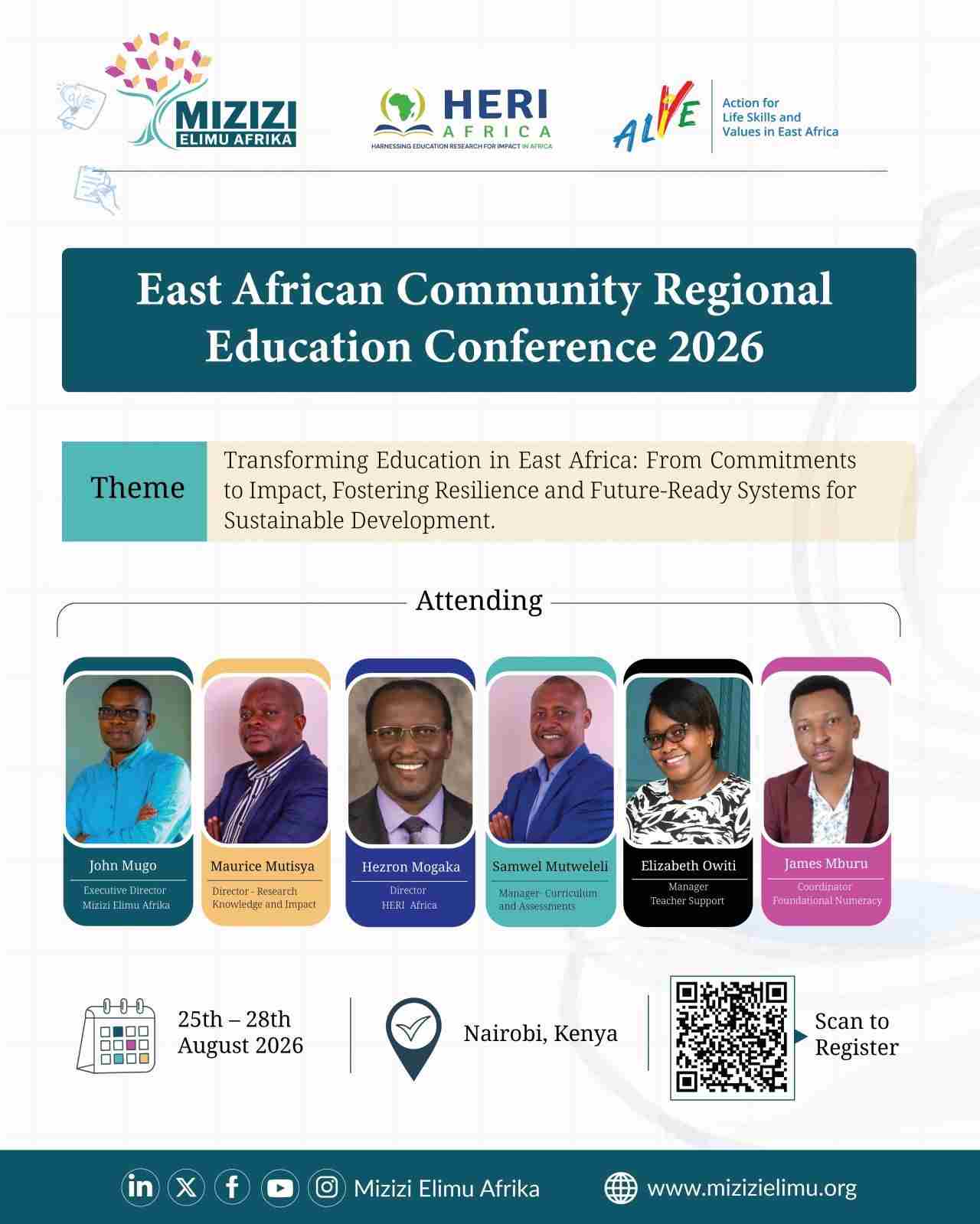
That question sits at the centre of the 2nd East African Community Regional Education Conference (EACREC 2026), which brings education leaders, policymakers, researchers, practitioners, development partners and young people to Nairobi from 25 to 28 August 2026.
Convened under the theme “Transforming Education in East Africa: From Commitments to Impact, Fostering Resilient and Future-Ready Systems for Sustainable Development,” the conference builds on the inaugural edition held at the EAC Headquarters in Arusha in 2024. It gathers stakeholders from the eight EAC Partner States around a shared challenge: how can the region move beyond commitments and promising interventions towards education systems that consistently deliver for every learner?
Mizizi Elimu Afrika will contribute evidence, facilitate conversations and learn alongside partners across sessions spanning foundational learning, early childhood development, competency-based assessment and community engagement.
Bringing foundational learning to the centre
A child’s ability to read, understand, reason, communicate and apply what they learn is the foundation on which all later learning is built. EACREC offers a regional space to interrogate why those foundations are still missing for so many children, examine what the evidence tells us, and identify what needs to change within education systems.
Our Executive Director, Dr John Mugo, will contribute to the Sub-Theme Spotlight Session, “Delivering on the Promise of Foundational Learning: What does it take?” alongside Winny Cherotich of PAL Network. The question is deliberately practical. We already know foundational learning matters; the greater challenge is moving from knowing what needs to be done to understanding how education systems can deliver it equitably and at scale.
Dr Mugo will also chair “Evidence, Equity, and System Reform for Foundational Learning,” bringing together evidence and experience on the reforms required to ensure that gains in access are matched by gains in learning.
Starting earlier: the place of early childhood development
The conversation on foundational learning must begin before children enter primary school.
During the pre-conference programme, Dr Maurice Mutisya, Director – Research, Knowledge and Impact, will join other education practitioners for “Are We Intervening Too Late? Role of Early Childhood Development in Foundational Learning.” The session examines how the early years shape children’s readiness to learn, and what that means for education policy, investment and programming.
Dr Charles Gachoki will contribute further evidence on early childhood education through his presentation, “From Evidence to Accountability: Inequalities in Access to Pre-Primary Education in Kenya’s Devolved System.”
Together, these conversations push past enrolment figures to ask who actually reaches quality early learning opportunities, who is being left behind, and how systems can respond.
Taking competency-based learning into the classroom
Education reforms ultimately come alive in the interaction between a teacher and a learner.
On 25 August, Samuel Mutweleli, Manager – Curriculum and Assessments, joins colleagues from Luigi Giussani Foundation, Milele Zanzibar Foundation and Uwezo Uganda to facilitate the pre-conference workshop “Designing Authentic Classroom Tasks for Competency-Based Learning.” The workshop explores how classroom tasks can move beyond testing recall to giving learners opportunities to demonstrate, practise and strengthen competencies.
This matters as education systems across East Africa pursue competency-based reforms. Policy ambition needs to be matched by practical support that enables teachers to translate reform into meaningful classroom experience.
Connecting evidence to policy and practice
Generating evidence is only one part of strengthening education systems. Evidence must also reach the people who can use it, inform decisions and contribute to changes in policy and practice.
James Mburu, Coordinator – Foundational Numeracy, will present “Acting Now: How Evidence and Practice Inform Policies” as part of a broader session examining what evidence, practice and policy reveal about closing foundational learning gaps. The conversation reflects a principle at the core of our work: evidence becomes most valuable when it moves beyond reports and publications and helps decision-makers, practitioners and communities make better choices for learners.
Joyce Kinyanjui and Mary Chepkemoi are also contributing as co-authors to work examining the Gender in Education Movement (GiEM) as a model for coalition-driven inclusive education reform in East Africa.
Learning through communities and partnerships
No single institution can transform an education system alone. That is why partnership and collective action remain central to both EACREC and our own approach.
On the final conference day, Dr Mugo and Elizabeth Owiti, Manager – Teacher Support, will contribute to “Strengthening Early and Foundational Learning through Community Engagement, Whole-School Approaches, and Systems Strengthening in East Africa.” Dr Mugo will serve as a discussant, while Owiti joins presenters from across the region sharing experience of connecting communities, schools and education systems in strengthening learning.
Our participation at EACREC also extends through HERI Africa and the ALiVE Programme, the wider partnerships through which we generate evidence, strengthen capacity and advance collective learning across the region.
Nine conversations, one regional ambition
EACREC 2026 explores nine interconnected areas:
• Early and foundational learning
• Teacher capacity and professional development
• Inclusive education
• EdTech, digitalisation and innovation
• TVET, skills development and youth agency
• Education financing, accountability and governance
• Data-driven decision-making and evidence-based policy
• Regional and continental partnerships
• Higher education
Running across all of them is a common recognition: transforming education requires more than isolated interventions. It requires strong foundations, capable teachers, useful evidence, responsive institutions, meaningful partnerships and education systems that keep the learner at the centre.
For Mizizi Elimu Afrika, the conference is therefore not simply an opportunity to present our work. It is a space to listen, learn, challenge our thinking and build the partnerships required to turn evidence into action.
As East Africa gathers in Nairobi, one question should stay with us across the four days:
What must we do differently so that the commitments we make today translate into better learning for every child?
We look forward to contributing to that conversation, and to the action that must follow.
EACREC 2026
25–28 August 2026
Safari Park Hotel, Nairobi, Kenya
Follow #EACREC2026 for updates across the four days.